Why CO₂ Drying Is Essential
Water is one of the most critical impurities that must be controlled before CO₂ liquefaction.
As CO₂ is cooled to low temperatures, residual moisture can freeze and form ice or hydrates inside heat exchangers, valves, pipelines, and other low-temperature equipment. This can increase pressure drop, reduce heat-transfer efficiency, and potentially interrupt plant operation.
For this reason, CO₂ must be effectively dehydrated before entering the liquefaction system.
A properly designed adsorption and drying system provides:
• Deep removal of residual moisture
• Stable low-temperature operation
• Protection of refrigeration and liquefaction equipment
• Reduced risk of freezing and blockage
• Improved CO₂ product quality
• Reliable continuous plant operation
CO₂ Adsorption and Drying Process
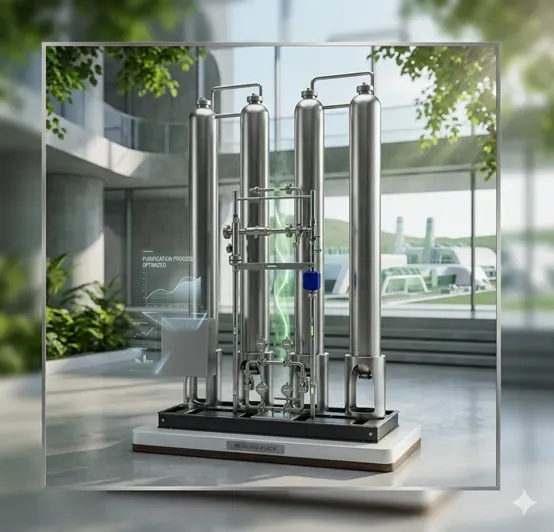
The YTC drying system typically uses adsorption technology with molecular sieve or other suitable adsorbents to remove residual moisture from the compressed CO₂ stream.
1. Compressed CO₂ Feed
After CO₂ compression and preliminary purification, the gas enters the adsorption and drying unit under controlled pressure and flow conditions.
The upstream treatment system removes bulk contaminants, while the drying unit provides deeper dehydration before liquefaction.
2. Adsorption
The wet CO₂ passes through an adsorption vessel containing a high-performance desiccant or molecular sieve.
Water molecules are selectively adsorbed by the solid adsorbent while the treated CO₂ continues through the system.
Multiple adsorption vessels can be arranged in parallel so that one vessel remains online while another is undergoing regeneration.
3. Regeneration
Once the adsorbent approaches its moisture-loading capacity, the vessel is isolated from the main CO₂ stream and regenerated.
Depending on the process design, regeneration can use controlled heating, dry CO₂, or another suitable regeneration method. The regeneration cycle removes accumulated moisture and restores the adsorption capacity of the desiccant.
4. Automatic Switching
The control system automatically switches between adsorption and regeneration vessels according to the programmed operating sequence.
This allows continuous CO₂ treatment without interrupting the main production process.
5. Final Dry CO₂
After passing through the drying system, the CO₂ reaches the required moisture level for downstream purification and liquefaction.
The dried gas is then transferred to the next process stage under controlled operating conditions.
Advanced Molecular Sieve Drying
YTC can select different adsorbents according to the feed gas characteristics and required product specification.
Molecular sieve adsorbents provide high adsorption capacity and are particularly suitable for deep dehydration applications where very low residual moisture levels are required.
The adsorption system can be engineered according to:
• CO₂ concentration
• Gas flow rate
• Inlet moisture content
• Operating pressure
• Required outlet moisture level
• Regeneration conditions
• Operating cycle
• Expected service life of the adsorbent
This allows the drying system to be optimized for the actual operating conditions of each project.
Protection of the CO₂ Liquefaction System
The drying unit works closely with the downstream refrigeration and liquefaction system.
Removing moisture before liquefaction helps prevent:
Ice Formation → Pipeline & Valve Blockage → Heat Exchanger Fouling → Pressure Drop → Unstable Liquefaction
Effective dehydration therefore improves both equipment protection and overall plant reliability.
The dried CO₂ can enter the liquefaction system under controlled conditions, where it is cooled and converted into liquid CO₂.
Integration with the Complete CO₂ Recovery Plant
The Adsorption & Drying Unit is normally integrated with other CO₂ treatment systems, including:
CO₂ Gas Pretreatment
↓
CO₂ Compression
↓
Purification
↓
Adsorption & Drying
↓
CO₂ Liquefaction
↓
Final Purification
↓
Liquid CO₂ Storage
The exact process sequence depends on the feed gas composition and required final CO₂ specification.
For gas streams containing significant amounts of sulfur compounds, hydrocarbons, oxygen, or other contaminants, additional purification stages can be incorporated before or after the drying section.
Automatic Control and Monitoring
YTC drying systems are equipped with automatic control to manage adsorption, regeneration, switching, pressure, temperature, and other critical operating parameters.
Depending on project requirements, the system can be integrated with the plant’s PLC, DCS, and online monitoring system.
Continuous monitoring of key parameters helps operators maintain stable drying performance and identify abnormal operating conditions at an early stage.
Customized for Different CO₂ Sources
CO₂ feed gas varies significantly between different recovery applications.
For example:
• Brewery CO₂: May contain moisture, alcohol, and fermentation-related impurities
• Ethanol CO₂: May contain moisture, ethanol, and other fermentation-related contaminants
• Flue Gas CO₂: May contain moisture, oxygen, nitrogen, and combustion-related impurities
• Chemical & Petrochemical CO₂: May contain sulfur compounds, hydrocarbons, moisture, and other process-specific contaminants
YTC selects the appropriate drying capacity, adsorbent, vessel configuration, regeneration method, and process sequence according to the actual gas conditions.
YTC CO₂ Adsorption & Drying Solution
YTC provides customized CO₂ purification, adsorption, drying, liquefaction, and storage solutions for different CO₂ recovery applications.
With 16+ years of experience in CO₂ treatment and recovery and 200+ CO₂ projects completed worldwide, YTC combines process engineering, equipment manufacturing, installation, commissioning, and technical support within an integrated project solution.
From initial gas analysis to final liquid CO₂ production, YTC designs each adsorption and drying system according to the customer’s feed gas composition, operating conditions, required moisture level, production capacity, and final CO₂ specification.