Engineered for Liquid CO₂ Storage
Liquid CO₂ must be stored under controlled pressure and temperature conditions. A reliable storage system therefore requires more than tank capacity alone—it must combine pressure-vessel integrity, effective thermal insulation, pressure management, accurate liquid-level monitoring, safe filling and withdrawal, and reliable process control.
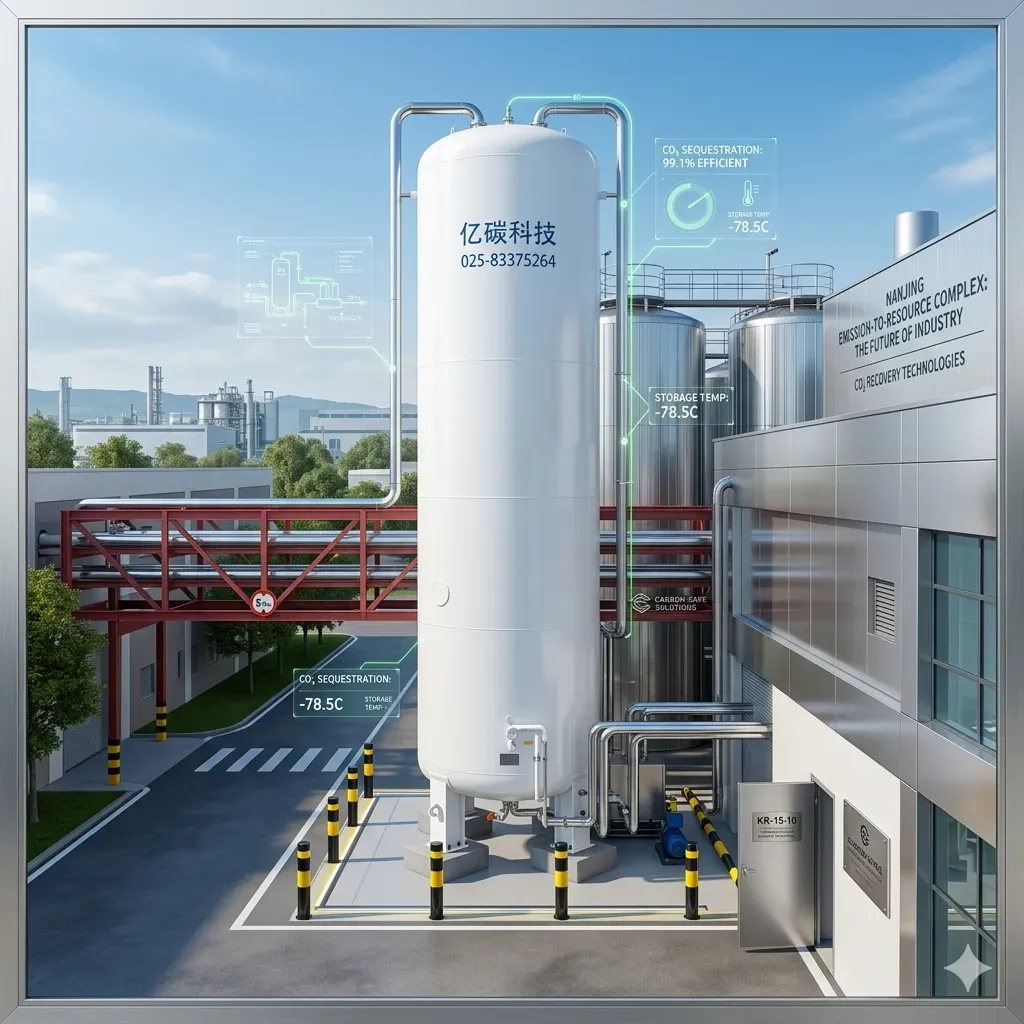
The YTC Liquid CO₂ Storage Tank is designed as an integrated storage system for continuous industrial operation.
- Liquid CO₂ pressure vessel
- Thermal insulation system
- Liquid and gas-phase piping
- Filling and withdrawal connections
- Pressure monitoring
- Liquid-level measurement
- Safety relief devices
- Isolation and control valves
- Transfer connections
- PLC/DCS integration
Storage Capacity Designed Around Your CO₂ Operation
Correct storage capacity is essential for the stable and economical operation of a CO₂ recovery plant.
A CO₂ recovery system may operate continuously, while liquid CO₂ is dispatched by tanker only at scheduled intervals. The storage tank must therefore provide sufficient capacity to absorb the difference between production and distribution.
- CO₂ production rate
- Daily operating hours
- Required storage days
- Tanker capacity
- Tanker loading frequency
- Transportation distance
- Customer consumption pattern
- Required reserve capacity
- Seasonal demand
- Future production expansion
Proper tank sizing allows the CO₂ recovery plant and downstream distribution system to operate more independently, helping reduce unnecessary production interruptions.
Pressure Vessel Construction
The inner pressure vessel is designed to contain liquid CO₂ under the specified operating conditions.
The vessel configuration, materials, wall thickness, welding procedures, inspection requirements, and testing are selected according to the applicable design code and project specification.
The storage tank is engineered as a complete pressure system rather than simply as a vessel shell. Nozzles, piping connections, valves, instrumentation, supports, and safety devices are considered together during engineering.
Depending on installation requirements, vertical or horizontal configurations can be evaluated to optimize storage capacity, site footprint, access, and plant layout.
Thermal Insulation and Product Holding
Effective thermal insulation is essential for maintaining stable liquid CO₂ storage conditions.
Heat entering the storage tank causes part of the liquid CO₂ to vaporize, which can increase internal pressure and lead to unnecessary product losses if not properly managed.
The insulation system is therefore designed to minimize heat ingress and support stable storage performance.
- Reduced heat ingress
- Controlled pressure rise
- Reduced unnecessary CO₂ losses
- Stable liquid CO₂ storage
- Improved operating reliability
- Better overall storage efficiency
Actual thermal performance depends on tank capacity, insulation design, filling level, operating pressure, ambient conditions, and storage duration.
Pressure Management
Maintaining the required tank pressure is essential for safe storage and reliable downstream supply.
The storage system can incorporate appropriate pressure monitoring, control, and protection devices according to the tank design and operating requirements.
The exact pressure-management philosophy is determined according to the storage conditions, downstream process requirements, and applicable safety regulations.
- Pressure indication
- Pressure transmitter
- Pressure-control valves
- Gas-phase connections
- Vent arrangements
- Pressure relief devices
- High-pressure alarms
Accurate Liquid-Level Monitoring
Reliable liquid-level measurement allows operators to understand available inventory and coordinate production, tanker loading, and customer deliveries.
The storage system can incorporate continuous liquid-level measurement together with high- and low-level alarms.
Liquid-level information can be integrated into the plant's PLC or DCS, allowing operators to monitor storage inventory from the central control system.
This information can also be used to coordinate the upstream liquefaction process. For example, when the storage tank approaches its maximum operating level, the control system can reduce or stop liquid CO₂ production according to the programmed control strategy.
Filling and Liquid CO₂ Withdrawal
The tank piping system is configured to support controlled filling and withdrawal of liquid CO₂.
- Liquid filling
- Liquid withdrawal
- Gas-phase connection
- Pressure equalization
- Tanker loading
- Venting
- Drainage
- Instrumentation
- Safety relief
Valve sizes, piping dimensions, connection standards, and transfer arrangements are selected according to the required liquid CO₂ flow rate and operating conditions.
For applications requiring frequent tanker loading, the storage and transfer system can be engineered together with the tanker loading station to improve operating efficiency.
Maintaining CO₂ Product Quality
For food-grade and other high-purity CO₂ applications, the storage system must preserve the quality achieved by the upstream purification and liquefaction processes.
Appropriate materials, valves, piping, connections, and operating procedures are therefore selected to minimize opportunities for contamination during storage and transfer.
The storage tank does not determine the final CO₂ purity by itself. Instead, it is designed to maintain the quality of the liquid CO₂ produced by the complete recovery and purification system.
Depending on the feed gas composition and overall process configuration, YTC CO₂ recovery systems can produce liquid CO₂ with purity up to 99.998%.
Minimizing Liquid CO₂ Losses
CO₂ lost during storage, venting, transfer, or tanker loading directly affects plant economics.
A properly engineered storage system can help reduce avoidable losses through effective thermal insulation, stable pressure management, correct tank sizing, proper valve selection, optimized transfer piping, controlled filling and withdrawal, and appropriate gas-return or recovery arrangements where required.
The objective is not only to store liquid CO₂ safely, but also to maximize the amount of recovered CO₂ that can ultimately be sold or used.
Integration with CO₂ Liquefaction
The storage tank is directly connected to the downstream side of the CO₂ liquefaction process.
Typical process: CO₂ Recovery & Purification → Adsorption & Drying → CO₂ Liquefaction → Liquid CO₂ Storage Tank → Tanker Loading / Dry Ice Production / Industrial Use
The storage system allows the upstream recovery plant to operate continuously even when downstream consumption or transportation is intermittent.
Through DCS integration, liquid level, tank pressure, alarms, and transfer status can be coordinated with the liquefaction system to provide stable overall plant operation.
Tanker Loading and CO₂ Distribution
For commercial CO₂ recovery plants, bulk storage is an important link between production and distribution.
- Liquid CO₂ road tankers
- CO₂ tank containers
- Cryogenic cylinders
- Dry ice production systems
- Beverage and food-processing facilities
- Industrial gas filling systems
- Other downstream CO₂ users
YTC can consider the storage tank together with the required loading and distribution equipment rather than treating each component as an isolated product.
YTC Liquid CO₂ Storage & Distribution Solution
YTC provides integrated solutions covering CO₂ recovery, purification, liquefaction, storage, loading, transportation, and downstream distribution.
With 20+ years of experience in CO₂ treatment and recovery and 200+ CO₂ projects completed worldwide, YTC combines process engineering, equipment manufacturing, project execution, installation, commissioning, and technical support for customers across global markets.
The Liquid CO₂ Storage Tank can be supplied as standalone equipment or integrated into a complete YTC CO₂ recovery and liquefaction plant.
Each storage solution is developed according to the customer's CO₂ production capacity, required storage volume, operating pressure, site conditions, transportation schedule, downstream consumption, and applicable project requirements.
From liquid CO₂ production to storage and final distribution, YTC provides an integrated solution designed for reliable operation, controlled product quality, efficient storage, and practical commercial distribution.
Applications
- Brewery CO₂ recovery plants
- Ethanol and fermentation CO₂ recovery plants
- Chemical and petrochemical CO₂ recovery
- Flue-gas CO₂ capture and recovery
- Food and beverage CO₂ supply
- Dry ice production plants
- Industrial gas filling stations
- CO₂ distribution terminals
- Water-treatment facilities
- Carbon capture and utilization projects
The tank capacity and configuration are engineered according to the actual production, storage, and distribution requirements of each project.