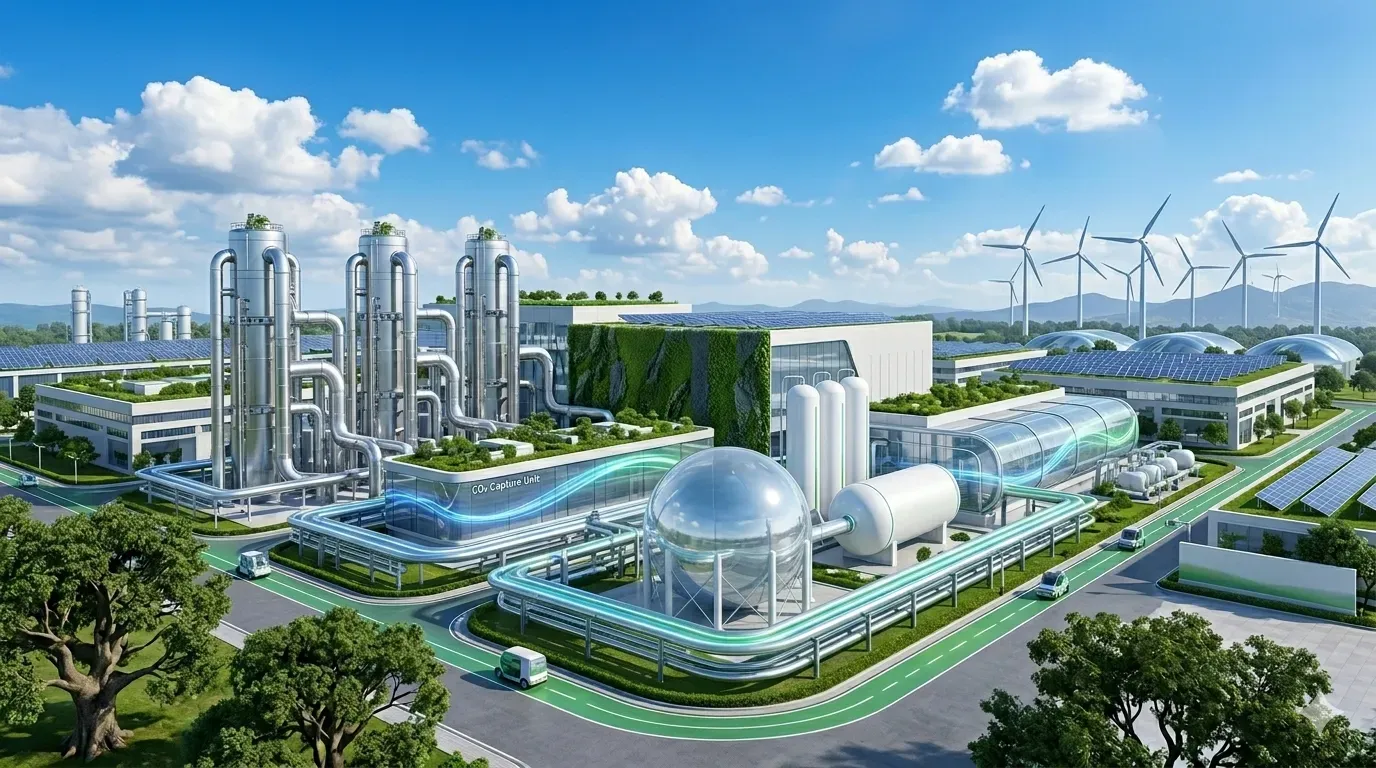
Food-Grade CO₂ Production Process
How Industrial CO₂ Is Purified for Food and Beverage Use
Food-grade CO₂ production requires control not only of total CO₂ purity but also of individual contaminants that may affect product safety, odor, taste and process performance.
A typical process is:CO₂ recovery plant captures carbon dioxide from an industrial gas stream, removes contaminants, compresses and dries the gas, and finally converts it into purified gaseous or liquid CO₂ for reuse or commercial sale.
CO₂ Source → Pretreatment → Compression → Purification → Deep Drying → Liquefaction → Rectification → Quality Monitoring → Storagebrewery fermentation, ethanol fermentation, molasses fermentation, chemical processes, biogas upgrading, dry ice production, or CO₂-rich industrial gas streams.
Source Matters
Common recoverable sources include:
- Brewery fermentation
- Ethanol fermentation
- Molasses fermentation
- Suitable industrial process gases
- Biogas-upgrading CO₂ streams
Each source requires a different purification strategy.
Purification Is More Important Than the Purity Number Alone
A statement such as:
CO₂ Purity: 99.998%
does not by itself establish food-grade quality.
A professional food-grade system must also control contaminants such as moisture, oxygen, hydrocarbons, sulfur compounds, carbon monoxide and source-specific impurities according to the applicable product specification.
YTC therefore designs purification according to feed-gas analysis + required final specification, rather than using one universal process for every CO₂ source.
Final Quality Control
Online CO₂ monitoring can be integrated into the plant, while laboratory analysis provides confirmation against contractual product requirements.
YTC's food-grade systems can be designed for high-purity liquid CO₂ production, with total CO₂ purity up to 99.998% depending on the source gas and selected purification process.
Step 2: Washing and Pretreatment
Fermentation CO₂ may contain water vapor, ethanol, foam, odors and entrained fermentation materials.
A washing and defoaming system removes these contaminants before compression.
Correct pretreatment protects downstream compressors, adsorbents, heat exchangers and purification equipment.
Step 3: CO₂ Compression
The cleaned gas is compressed to the pressure required for downstream purification and liquefaction.
Compression is one of the major energy-consuming operations in a CO₂ recovery plant, making compressor selection, staging and cooling important to overall plant efficiency.
Step 4: Purification
Different feed gases require different purification technologies.
Depending on the project, YTC systems can incorporate:
- Multi-stage water washing
- Activated-carbon adsorption
- Molecular-sieve adsorption
- PSA purification
- Deodorization
- Impurity separation
- Final rectification
The objective is not simply to increase total CO₂ concentration, but to control individual contaminants according to the required product specification.
Step 5: Drying
Water must be removed before low-temperature liquefaction.
Residual moisture can freeze in low-temperature equipment and cause operating problems. Adsorption drying therefore provides the very low moisture level required for stable refrigeration and liquefaction.
Step 6: CO₂ Liquefaction
Purified and dried CO₂ is cooled under pressure until it condenses into liquid CO₂.
Non-condensable gases such as oxygen and nitrogen remain preferentially in the gas phase and can be separated during the liquefaction and purification process.
Step 7: Final Purification and Storage
Depending on product requirements, additional rectification or stripping can further remove light impurities.
The finished liquid CO₂ is then transferred to insulated storage tanks before being supplied to tankers, tank containers, dry ice systems or downstream users.
YTC systems can be engineered to produce CO₂ purity up to 99.998%, depending on feed-gas composition and process configuration.
YTC CO₂ Recovery Experience
YTC has executed more than 200 CO₂ treatment and recovery projects worldwide, covering fermentation, brewery, ethanol, industrial gas, flue gas and biogas applications.
Its engineering capability ranges from approximately 80 kg/h to 20,000 kg/h, allowing the process to be configured for both relatively small recovery systems and large industrial plants.
The fundamental principle remains the same:
Capture CO₂ that would otherwise be lost, remove the contaminants, convert it into a usable product, and return that CO₂ to the industrial value chain.