Engineered for Liquid CO₂ Transportation
Liquid CO₂ requires controlled pressure and temperature conditions throughout storage and transportation. An effective transport system must therefore combine pressure-vessel integrity, thermal insulation, operational safety, and efficient loading and unloading.
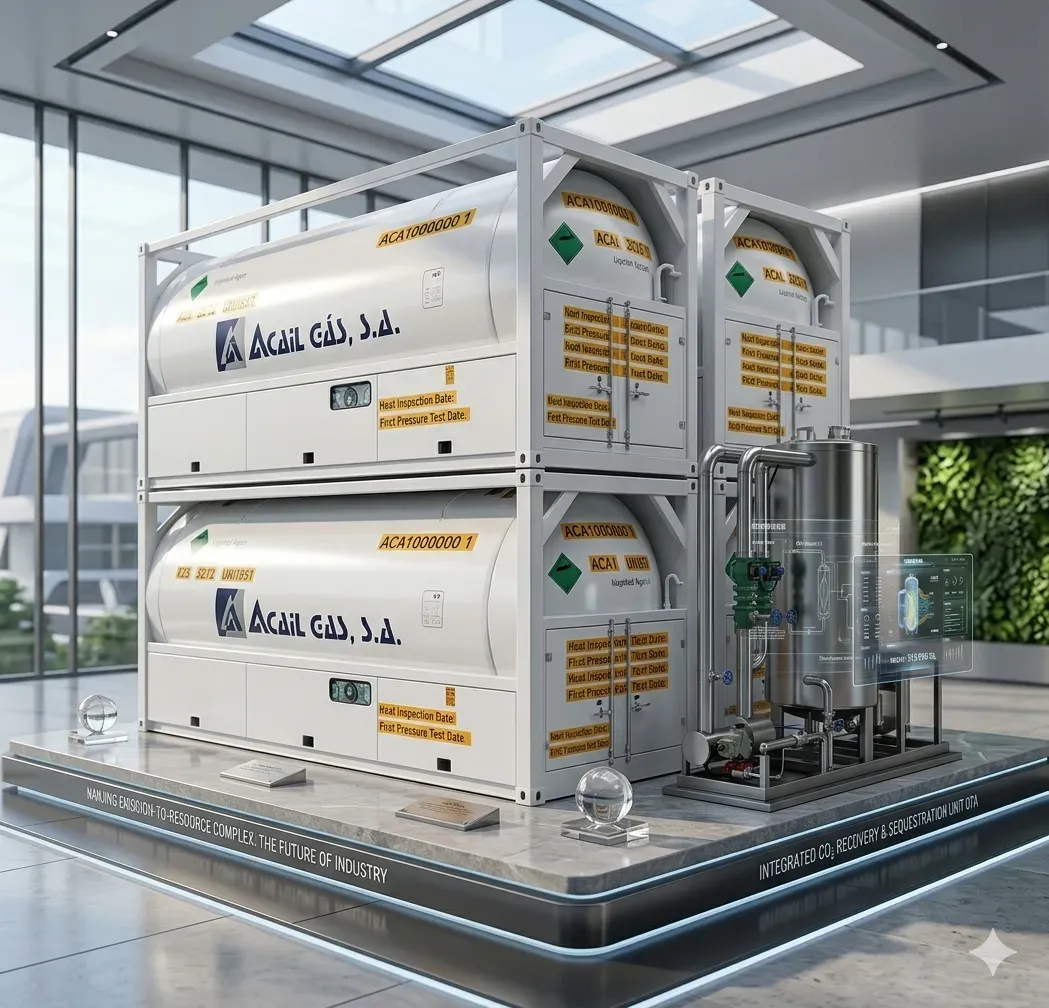
The YTC Liquid CO₂ Tank Container integrates these requirements into a compact transportable system.
The pressure vessel is installed within a high-strength container frame designed to facilitate handling and transportation. The tank configuration, operating pressure, insulation system, piping, valves, and instrumentation can be engineered according to the required liquid CO₂ capacity and operating conditions.
Double-Wall Cryogenic Tank Construction
The Liquid CO₂ Tank Container is based on a double-wall, vacuum-insulated pressure-vessel design.
Inner Vessel
The inner vessel contains the liquid CO₂ and is designed for the specified operating pressure and low-temperature service conditions.
Material selection, vessel thickness, welding procedures, inspection, and testing are determined according to the applicable pressure-vessel design requirements.
Vacuum-Insulated Annular Space
The space between the inner and outer vessels forms the thermal insulation zone.
A high-vacuum multi-layer insulation system minimizes heat transfer from the surrounding environment to the stored liquid CO₂.
Reducing heat ingress helps limit pressure rise and supports stable liquid CO₂ storage during transportation.
Outer Vessel and Container Frame
The outer structure provides mechanical protection for the insulated pressure vessel, while the high-strength container frame supports transportation, lifting, handling, and installation.
The complete assembly is engineered as an integrated storage and transportation system rather than simply a pressure vessel installed inside a frame.
High-Vacuum Multi-Layer Insulation
Thermal performance is one of the most important considerations in liquid CO₂ transportation.
Heat entering the tank causes part of the liquid CO₂ to vaporize, increasing the internal pressure. Effective insulation therefore plays an important role in maintaining stable storage conditions and minimizing unnecessary product losses.
YTC uses high-vacuum multi-layer insulation to reduce heat transfer between the ambient environment and the inner pressure vessel.
The insulation system is designed to provide:
- Low heat ingress
- Controlled pressure rise
- Stable liquid CO₂ storage conditions
- Reduced product losses
- Reliable performance during transportation
Actual thermal performance and holding conditions depend on tank capacity, operating pressure, filling level, ambient conditions, insulation design, and transportation duration.
Filling and Discharge System
The tank container can be configured with dedicated piping and valves for safe and efficient liquid CO₂ filling, discharge, pressure control, and operational monitoring.
Depending on project requirements, the piping system can incorporate:
- Liquid filling connections
- Liquid discharge connections
- Gas-phase connections
- Pressure indication
- Liquid-level indication
- Pressure-control components
- Safety relief devices
- Isolation valves
- Drain and vent connections
Valve arrangement, connection standards, instrumentation, and operating interfaces can be customized according to the customer’s filling station, storage facility, and transportation requirements.
Safety and Pressure Protection
Safe transportation of liquid CO₂ requires effective management of internal pressure and operating conditions.
The tank container is engineered with pressure protection and operating controls appropriate to the selected design configuration.
Depending on the applicable design code and project requirements, the system can incorporate pressure relief devices, pressure and liquid-level instrumentation, emergency isolation arrangements, and other safety components.
Pressure-vessel fabrication, welding, inspection, testing, and safety-device selection are carried out according to the applicable project requirements and specified design standards.
Intermodal Transportation by Road, Rail and Sea
Containerized construction provides flexibility for transporting liquid CO₂ across different logistics networks.
The Liquid CO₂ Tank Container can be configured for road, rail, and sea transportation, allowing the same transport unit to move between different modes with reduced product handling.
This makes tank containers particularly suitable for:
CO₂ producers and recovery plants
Industrial gas companies
Food and beverage CO₂ distribution
Dry ice production facilities
CO₂ filling and distribution terminals
Industrial CO₂ users
Regional and international liquid CO₂ logistics
The required transport approvals and design configuration should be selected according to the destination country and intended transportation mode.
From CO₂ Recovery Plant to Customer
For CO₂ producers, the tank container can form an important link between the production plant and the downstream market.
A complete liquid CO₂ supply chain can include:
CO₂ Recovery & Purification
↓
CO₂ Liquefaction
↓
Liquid CO₂ Storage Tank
↓
Tank Container Filling
↓
Road / Rail / Sea Transportation
↓
Customer Storage or Distribution Terminal
For customers operating YTC CO₂ recovery plants, the tank container can therefore be integrated into the overall project as part of the liquid CO₂ storage and distribution solution.
Customized for Different Project Requirements
Liquid CO₂ transportation requirements vary according to local regulations, logistics routes, filling infrastructure, and end-user requirements.
YTC can customize the tank container according to:
Required liquid CO₂ capacity
Working pressure
Container dimensions
Filling and discharge arrangement
Valve and piping configuration
Instrumentation requirements
Transportation mode
Destination-country requirements
Site and operating conditions
Design codes, transport approvals, inspection requirements, and documentation can be specified according to the applicable project and destination requirements.
Applications
YTC Liquid CO₂ Tank Containers can support liquid CO₂ transportation for a wide range of industries and applications, including:
- Food and beverage CO₂
- Brewery and ethanol CO₂ recovery
- Dry ice production
- Industrial gas distribution
- Chemical processing
- Greenhouse CO₂ supply
- Water treatment
- Industrial CO₂ applications
- CO₂ recovery and utilization projects
YTC Liquid CO₂ Storage & Transportation Solution
YTC provides more than individual CO₂ transport equipment. The tank container can be integrated with a complete CO₂ recovery, purification, liquefaction, storage, loading, and distribution system.
With extensive experience in CO₂ recovery and liquid CO₂ handling, YTC can engineer the storage and transportation configuration according to the customer’s production capacity, liquid CO₂ output, logistics requirements, storage strategy, and downstream market.
From the CO₂ recovery plant to final delivery, YTC provides an integrated solution designed to help customers produce, store, transport, and distribute liquid CO₂ safely and efficiently.